
If you’ve been watching ONDO over the past few months and wondering why the price seems stuck while everything else in crypto grabs headlines, you’re not imagining it. But a closer look under the hood — specifically at how volume has behaved, not just price — tells a more interesting story than the chart alone suggests.
What is ONDO, and why does it matter?
Ondo Finance is one of the leading projects in the “real-world assets” (RWA) corner of crypto — the part of the industry focused on putting traditional financial products like US Treasuries and money market funds directly on the blockchain. Its flagship products, OUSG and USDY, let investors hold tokenized exposure to short-term government debt, with the kind of instant settlement and 24/7 access that traditional finance simply can’t offer. Ondo Finance has moved assets backing OUSG into BlackRock’s BUIDL tokenized fund, enabling instant, around-the-clock subscriptions and redemptions.
That institutional pedigree is a big part of the bull case. In May 2026, Ondo Finance took part in a cross-border tokenized US Treasury settlement pilot tied to J.P. Morgan, Mastercard and Ripple, and was linked to a DTCC-backed tokenized assets initiative — the kind of partnerships that signal Wall Street isn’t just watching this space, it’s actively building on it. Ondo’s total value locked has grown substantially as a result, and the ONDO token itself functions as the governance layer for the whole ecosystem.
Reading the accumulation story in the chart
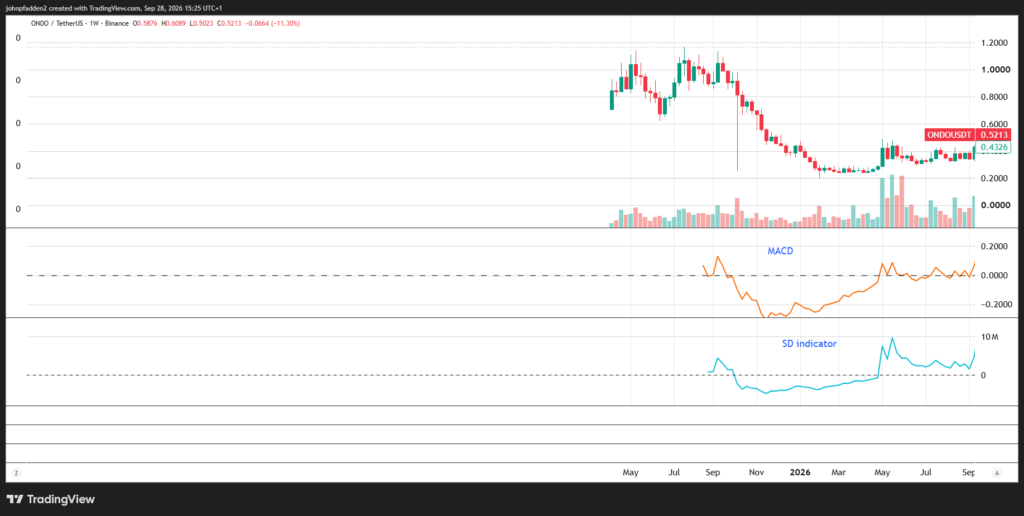
Price alone on the weekly chart tells a fairly unremarkable story: a sharp run-up into late 2025, a hard correction, and a long stretch of sideways chop since. But price only tells you what happened to the last trade — it doesn’t tell you how many buyers are actually still holding.
That’s where volume-based indicators like the SD index become useful alongside something like MACD. Both are momentum tools, but they weight things differently: MACD is essentially a comparison of moving averages of price, while SD factors in price change and the volume behind it. If every week traded the same volume, the two would move roughly in step with each other. When they diverge, volume is telling you something price isn’t.
That divergence is exactly what shows up on ONDO’s weekly chart from around October 2025 onward. While MACD dropped well below its zero line during the correction — consistent with the price decline — SD’s drop below zero was comparatively shallow. That’s a classic signature of accumulation: sellers were pushing price down, but they weren’t doing it on heavy, committed volume. Buyers were quietly absorbing supply the whole way down.
Then came the big volume spike in May 2026, coinciding with the institutional news flow above. Since then, price has drifted sideways — but critically, it hasn’t given back anywhere near as much of that volume-weighted momentum as the price action alone would suggest. In other words, the buyers who stepped in during that surge largely haven’t been shaken out. The sideways action since late April looks less like distribution and more like a real base being built on top of retained buying pressure.
Why this matters going forward
Sideways price with retained volume-based strength is often a sign of a market absorbing supply rather than losing interest. If that read is correct, it implies that a meaningful chunk of ONDO’s float has moved into hands that aren’t selling at current prices. Should broader crypto market conditions turn favorable — particularly if Bitcoin resumes a clear uptrend and capital starts rotating back into altcoins — ONDO could find that there simply isn’t much supply sitting overhead to absorb renewed demand. That’s the setup where price can move quickly: not because new buyers suddenly appear, but because there’s comparatively little resistance left to work through.
The caveat This is technical analysis, not financial advice — do your own research before acting on it. Bitcoin’s broader trend will likely set the tone for when this resolves. But the volume story here is a real signal, not noise, and it’s the kind of setup worth having on your radar as the RWA sector continues to mature.